Physical labor and time
Out Stealing HorsesPhysical labor and time are bound together in Trond Sander’s effort to make a life in the forest: work gives duration a bodily rhythm, while the body’s limits make that duration palpable. In the present, he chooses to repair his house himself because the task will take time; in memory, long days of timber work with Trond’s father become an almost seamless pulse of shared effort. Across both periods, labor is not simply a means to an end but a way to inhabit time and keep it from disappearing unnoticed.
Time Given a Physical Shape
Trond is pleased to have acquired the house and grounds, though much needs doing and the property attracted little competition. He could afford to hire a carpenter, but doing so would make the work go too quickly. He wants to use the time required to put the place in order. His distinction is not between time passing quickly and time passing slowly: he wants time to be something he lives inside, filled with physical tasks that divide it into recognizable portions. Work gives duration texture and sequence, helping it become distinct rather than vanish while he is not looking.
This preference belongs to a chosen solitude. Trond has longed for a place where silence could replace company, and now that he has it, practical work provides a counterweight to isolation without dissolving it. The house needs attention; the forest supplies materials and demanding tasks. Instead of treating the labor as an obstacle to a finished home, he values the process itself. The desired result matters, but so does the duration spent reaching it.
The Father’s Inherited Method
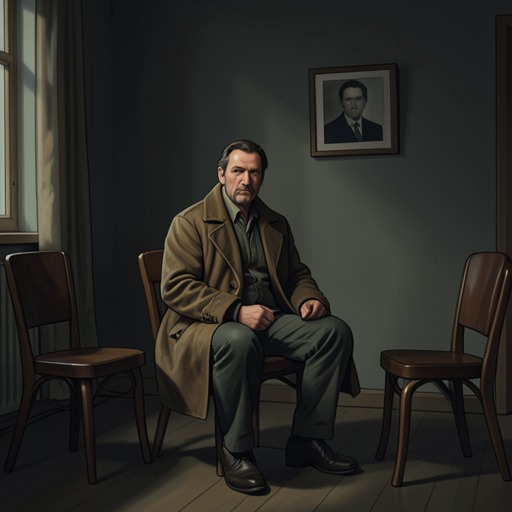
Trond’s practical ability is less a matter of confidence than of remembered observation. When faced with a task beyond ordinary daily chores, he closes his eyes and pictures how Trond’s father would have done it, or recalls watching him do it. Trond then imitates those movements until he finds the proper rhythm and the task becomes intelligible. He describes work as having a context buried within it: one action follows another, and the completed form seems to be there already, waiting for the body’s movements to disclose it.
This private method makes skill a form of inheritance enacted in the present. Trond does not simply remember a lesson or repeat an instruction; he watches his father’s movements again in imagination and lets them guide his own body. The remembered father is barely forty, the age he was when Trond last saw him at fifteen, and will never grow older in Trond’s mind. Thus the working method preserves a particular image of the father even as Trond uses it to perform new tasks in a later life. When a friendly mechanic asks about his abilities, Trond gives the simpler explanation that he had a practical father and learned a great deal from him; the private ritual behind that answer remains undisclosed.
The Timber Work’s Shared Rhythm
In the remembered forest labor, time is measured by sustained effort and necessary rest. The workers begin shortly after seven in the morning and continue until evening, sleep through the night, and return to the work when they wake with the light. Each spruce must be felled with a cross-cut saw; counted tree by tree, the wood seems almost endless. Yet once the workers fall into a shared rhythm, beginning and end lose their immediate importance. The work continues through a pulse of sawing, pauses, food, and sleep, with breaks taken at the right time and enough rest to resume.
The rhythm is not effortless. Trond works among the spruce branches with a hatchet, trimming them close to the trunk as his father had shown him. That care matters because branches left sticking out could obstruct the shaving tool or injure men who might have to run along logs when floating timber tangled and blocked the river. Resin coats Trond’s clothes, hair, and skin; its scent follows him to bed and remains with him through the day. He becomes so absorbed that the others have to restrain him, sit him on a stump, and tell him to rest. Even then he rises again. The remembered scene makes labor both bodily pleasure and bodily excess: fatigue is present, but the momentum of the work temporarily overwhelms his awareness of it.
The labor is collective, though its demands fall differently on those present. Trond’s father, Franz, Jon’s mother, and the other workers share the work and the pauses. Jon’s mother also rows home to look after Lars, then returns by boat, sometimes bringing tools or food she has been asked to fetch. She works as hard as any of the men and keeps moving between the river and the worksite. The routine therefore depends not only on the visible labor of felling and trimming trees but also on the repeated journeys and provisions that allow the group to continue.
Work in the Present: Measure and Limit
In the present, Trond’s labor is solitary and organized around his own pace. He cuts the dead spruce with a chainsaw, carries the resulting chunks three at a time in a wheelbarrow, and tips them onto a heap outside the woodshed. The stack rises into a two-dimensional pyramid almost two metres high against the wall beneath the eaves; splitting the wood is still to come. These successive tasks turn an immense fallen tree into manageable stages, each with its own physical endpoint.
At the end of one day, Trond stops at five o’clock, as dusk seeps from the forest and his back has had enough. He cleans the saw, leaves it to dry in the woodshed, removes his damp boots, and brushes wood chips and dirt from his clothes and socks. The carefully described clearing-up is part of the work’s measure: the day ends not in an abstract passage of hours but in an emptied Thermos, cleaned equipment, tired muscles, and the small heap of debris from his clothes. Lyra waits with a pine cone, but Trond has no energy to begin their game; he pats her and declines. The bodily limit that once had to be imposed on the feverishly persistent younger worker is now acknowledged as a reason to stop.
The contrast between the two periods does not make labor merely a symbol of age or loss. It shows how the same principle changes with circumstance: time becomes livable when it is given tasks, rhythms, pauses, and endings. In the forest memory, the group’s labor seems to gather everyone into one pulse; in the present, work orders Trond’s solitude while also making its physical cost unmistakable. A house is put in order gradually, a tree becomes a stack of firewood, and an otherwise elusive stretch of time acquires a shape the body can feel.